

Last night we sat down in the shop for a two-hour live Q&A. Over sixty questions came in from viewers across the country and one from Norway. This post pulls out the pieces that felt worth writing down, so if you missed the stream, or you did watch and want to find one answer again, you have a place to come back to.
The full replay is here: Kibler's Longrifles live Q&A, August 19, 2026. Every section below links to the exact moment in the recording.
Where all of this started
We asked Jim near the end of the night what got him into muzzleloaders in the first place, and his answer said a lot about the shop.
"I grew up in a family that was interested in history and I always liked to make things and build things. That's kind of the combination. I lived in old houses that were built in the early 1800s and my family collected antiques. I liked to hunt and fish as a kid and I put a kit gun together that happened to be one that was at my grandparents' house. I just kind of got interested. It's a neat thing for me because it's something that's very useful. Hunting was very cool at the time to me, but also had so much history around it as well, and beauty and artistic details and creativeness. So, all those things came together that got me interested in these muzzleloaders."
That last sentence is really the whole shop in one line. History, beauty, and making things by hand, together in the same object.
Watch this exchange at 2:03:02 in the replay.
On people modifying the rifles we make
A viewer asked whether it bothers Jim when builders change parts on a Kibler kit, swapping ramrod pipes, locks, or side plates. His answer was honest, and it says a lot about how he thinks about what we sell.
"A little bit. It just depends, because sometimes people do really neat stuff, but I'm a traditionalist and I come from a background of just obsessing over every detail and making custom guns. These are almost, even though we do them in a production fashion, they're almost like a custom gun that I'm putting out to people. So seeing some modifications are tough, especially if they're maybe not historically correct or they're a little bit odd. But at the same time, I understand. It's your gun and your project, and you've worked hard to buy it."
We design the kit and CNC-machine every part. The hand work belongs to the builder. Both of those things are true at once, and Jim's answer here is what that tension actually feels like from the design side.
The pistol and where it came from
The pistol kit is the next thing we are releasing, so it came up several times. The design story is worth telling.
"The originals that our pistol kit is based on by Sheets, it just had two washers. They were decorative a little bit. But I decided to put a bigger side plate on it just because I thought it added a little more interest. But we may do it without a side plate too for somebody that doesn't want that, would rather do it in more of the English dueling pistol style. And these pistols are based off of work by Sheets in Virginia. However, you can definitely see that the English dueling pistols with faceted grips very much influenced these pistol designs."
So the pistol is Virginia work, influenced by English dueling pistols, and Jim is leaning toward iron hardware because "there were huge numbers of English pistols with iron hardware." Calibers will be .45, .50, and .54. A side-plate-free option may come later for builders who want a cleaner English look.
Start at 5:21 for the side-plate discussion, 1:04:47 for the iron hardware reasoning, and 1:51:58 for the lock.
A Hawken traded for a small boat
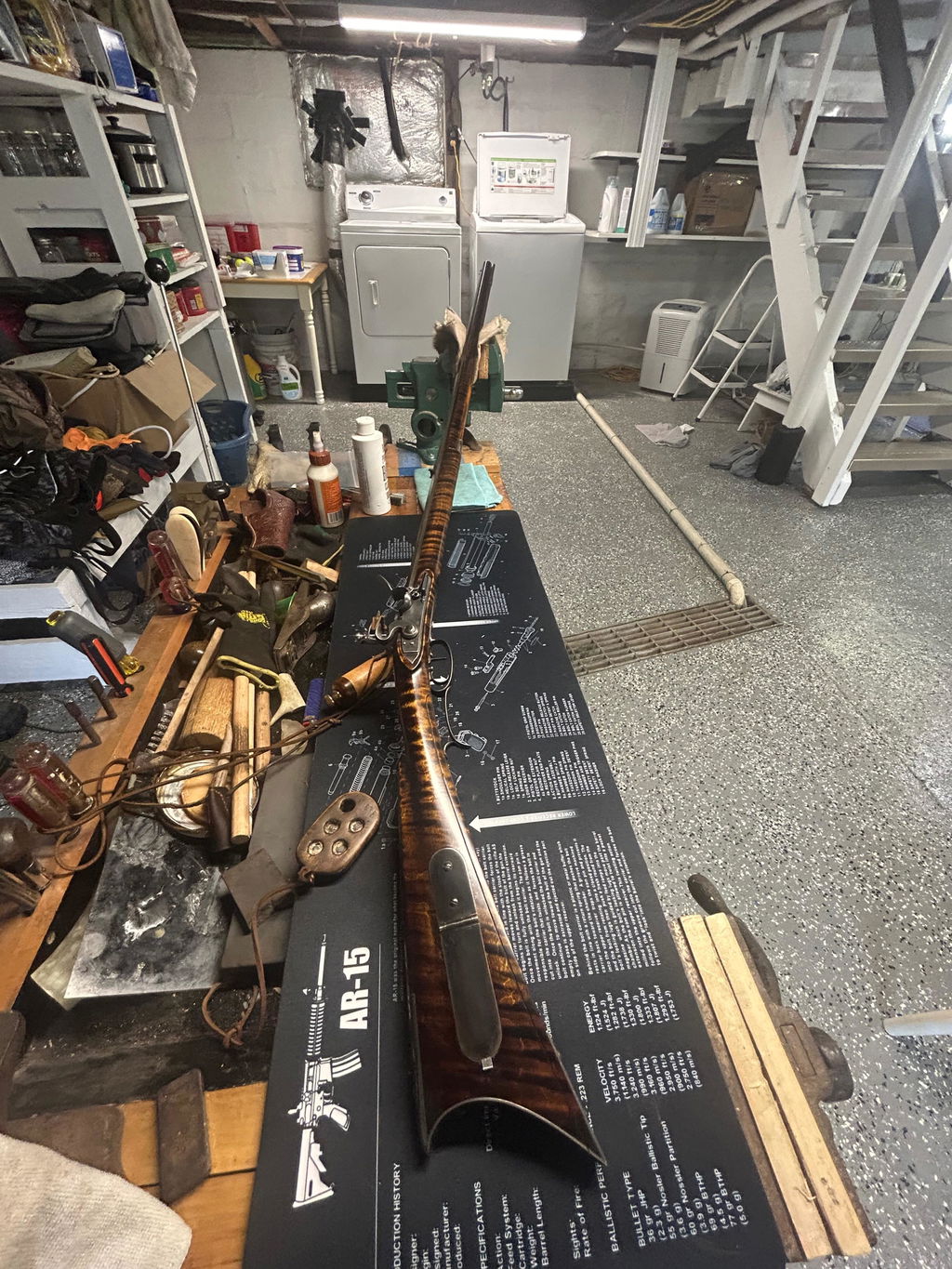
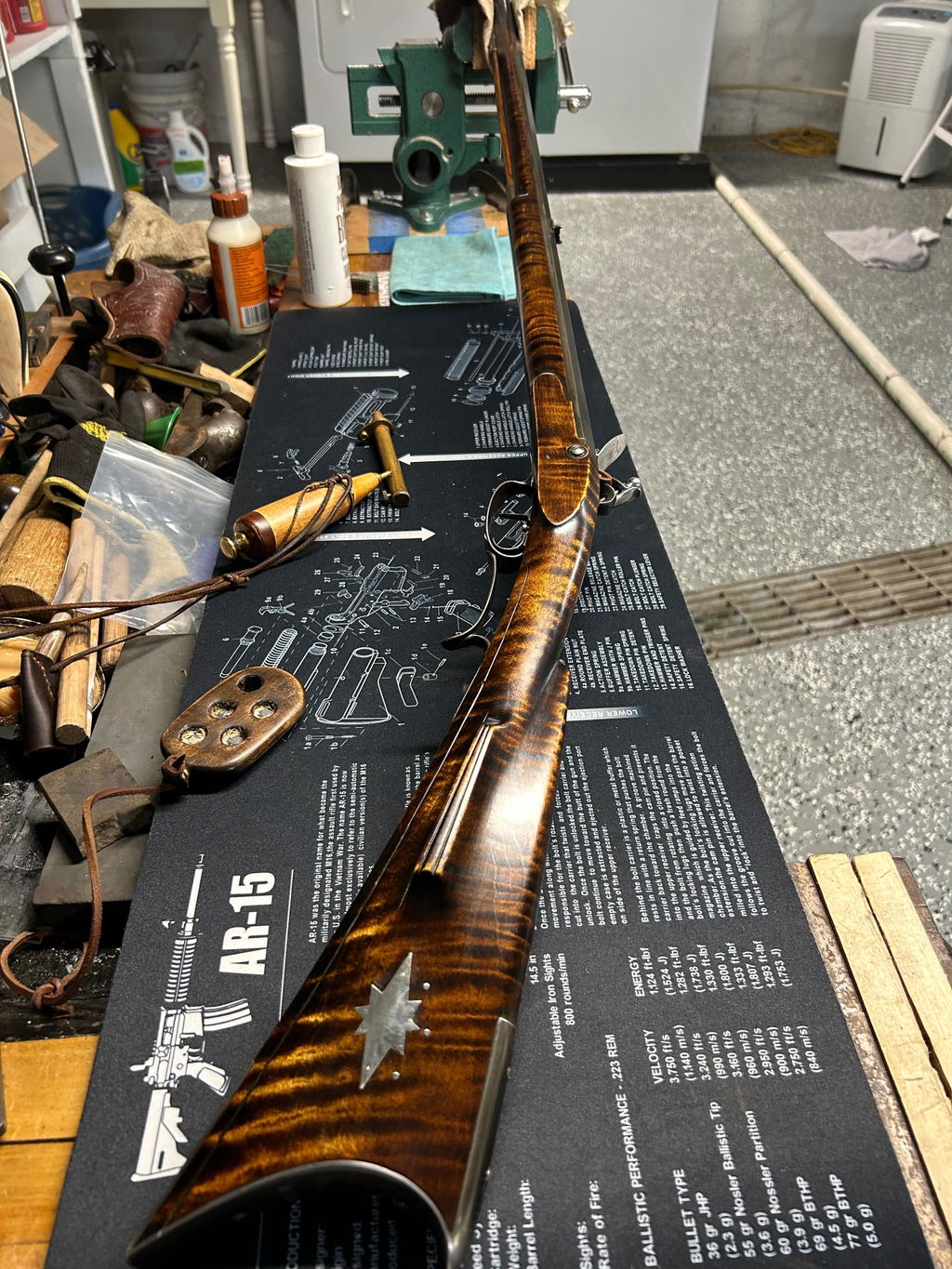
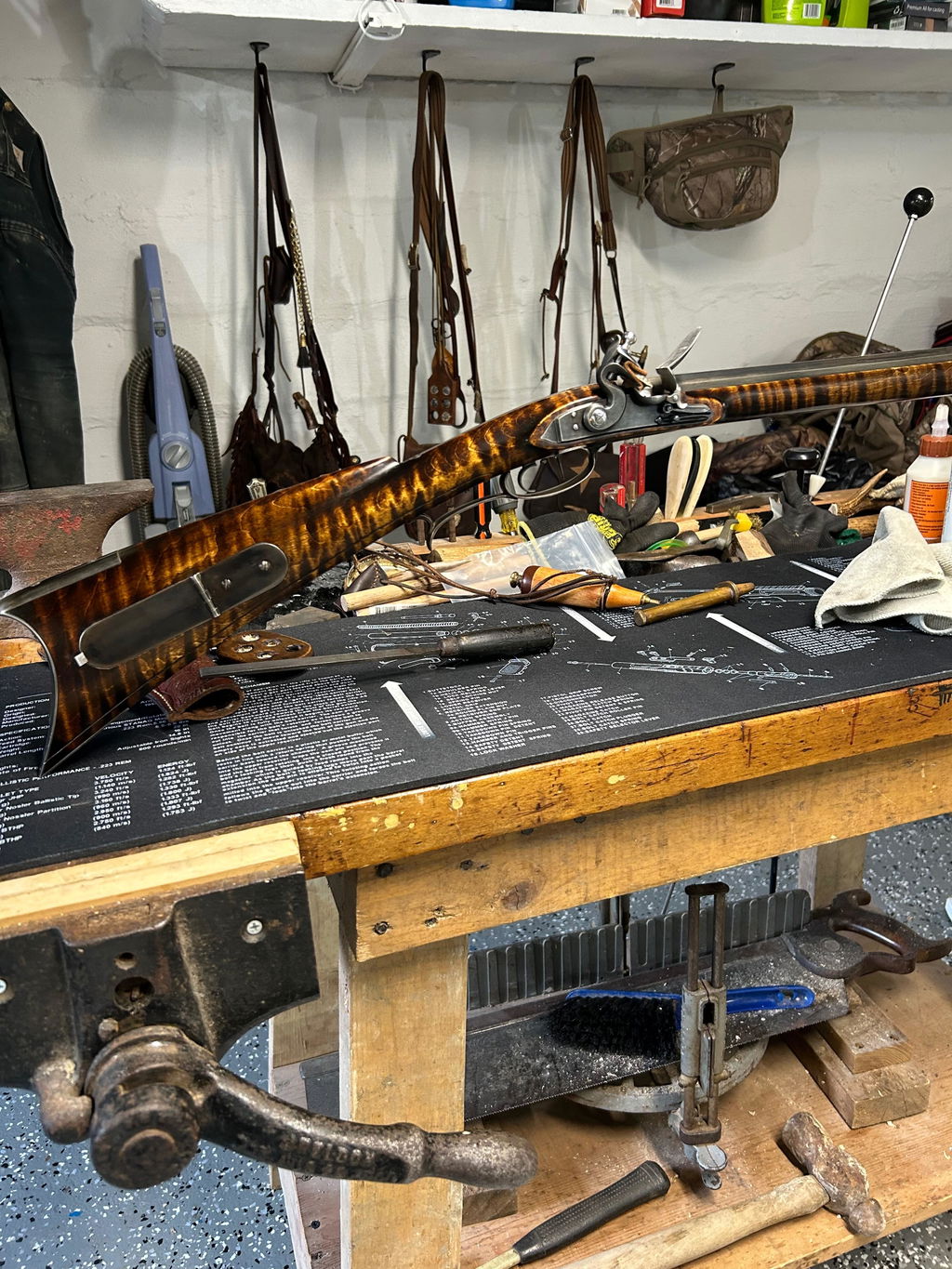
At one point Jim held up a rifle behind him and told the story of the wood in it.
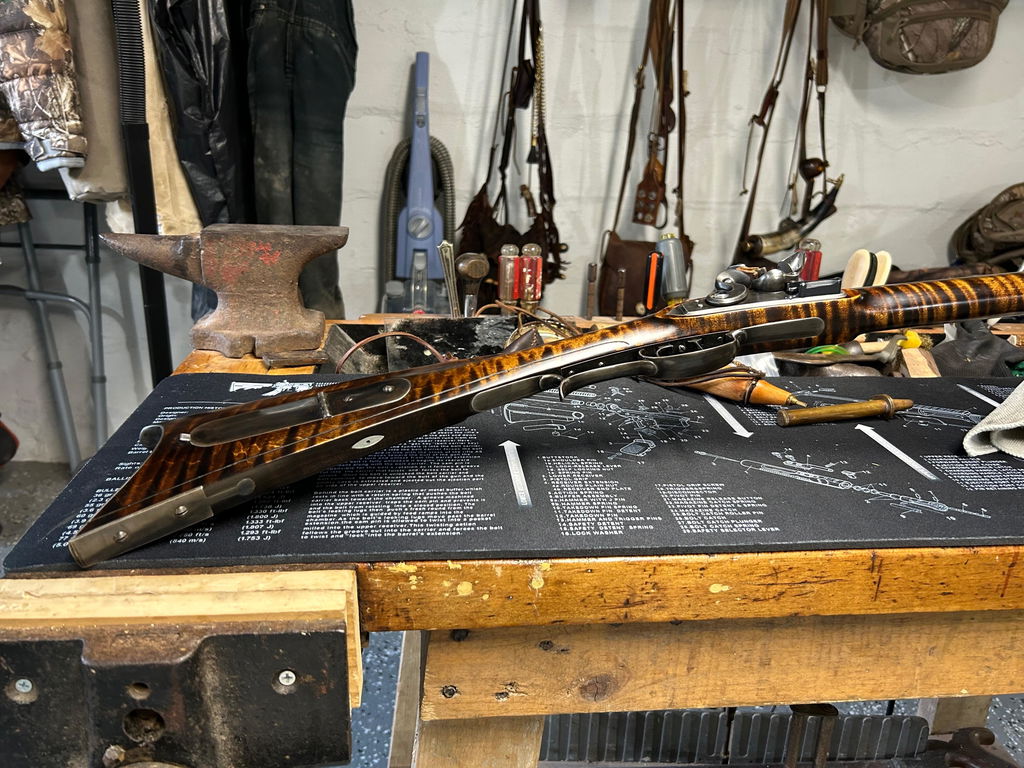
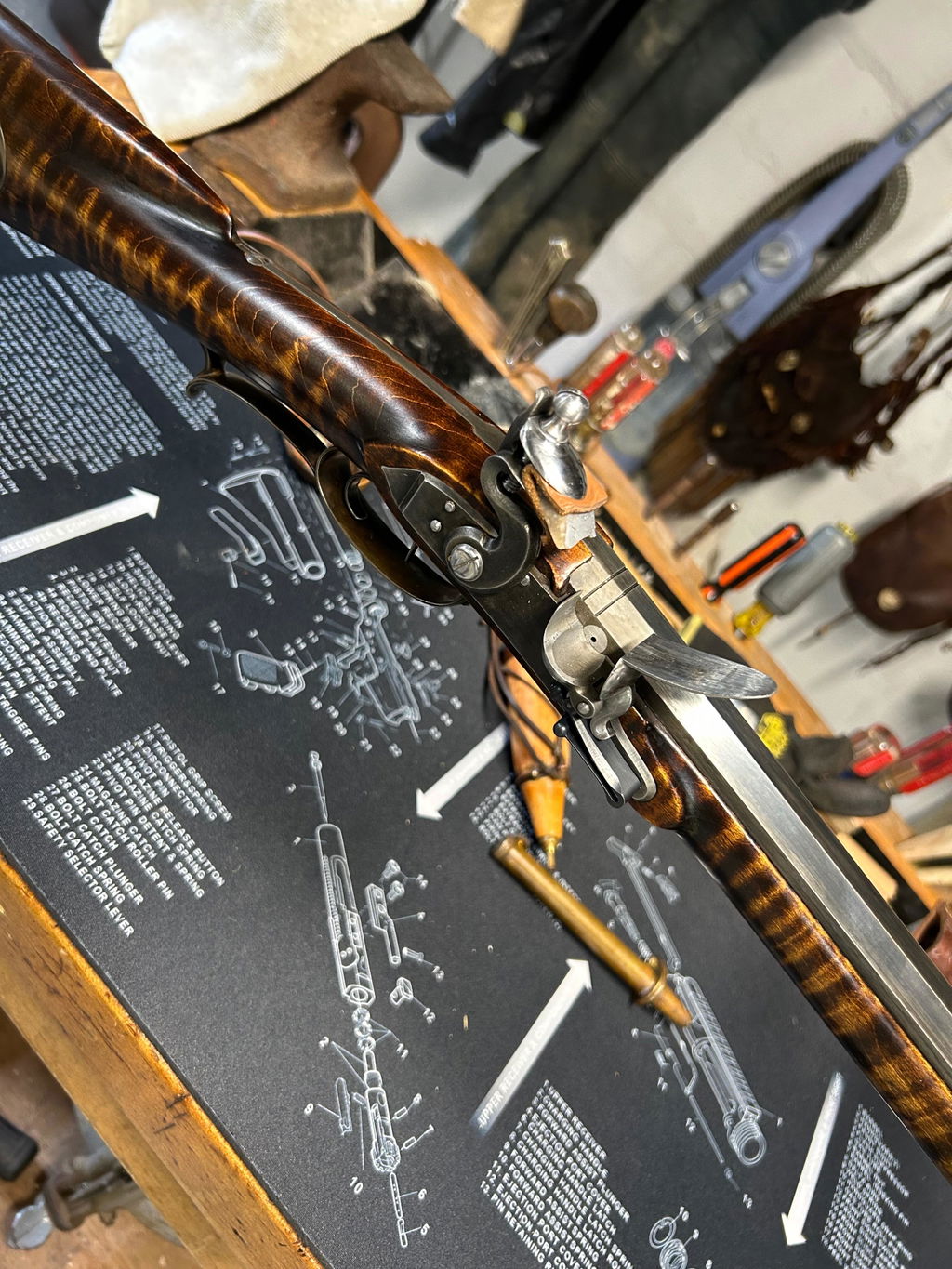
"This finished by one of our employees and I traded him a little small boat for it. He wanted the boat and I like the gun that he did. The wood came from up near Cadillac, Michigan. Not super hardwood, a little softer than you might expect, but hard enough to do the job. But the figure was just pretty incredible in it."
The wood glows in the video, Katherine's word for it. That is the kind of piece we're talking about when we say the finished rifle is an heirloom.
What's coming next
We got a lot of "when will X be available" questions. Here is what Jim said, without commitments on dates.
- The pistol is closest. Iron hardware, .45, .50, .54. Lock style still being finalized.
- Brown Bess, the 1756 pattern (made in 1759), is nearly designed. Lock internals and sling swivels remain, then figuring out how to make everything. The pistol will come first. 8:56
- A relief-carved Colonial, likely as a relaunch of the current Colonial with carving available. 1:07:09
- A Germanic-style lock, which Jim wants to get going on after the pistol and Brown Bess are done. Several future guns need it. 1:07:09
- Chokes in the Fowler, a proper turkey choke, not a jug choke. 1:12:40
- A golden-age Pennsylvania gun eventually, though Jim said we would probably start with earlier work like a Beck or Dickert first.
Practical answers, in one place
Since so many of the questions were building questions, here are the ones we get asked most often, with timestamps if you want to hear Jim explain.
For a solid blue-black metal finish, rust bluing is the recommendation. Jack's Black, which we sell, is for simulated patina. Charcoal blue also works but is harder. 12:57
For fancy maple, Jim's approach uses tannic acid followed by iron nitrate on hard maple, and he answered the follow-up on the process in detail. 16:12
For barrel cleaning, water and dish soap. That is all you need for the bore and lock. 27:34
For reference books on Pennsylvania long rifles, Jim named two: Rifles of Colonial America, Volume One and Kindig's book. He also recommended the CDs from the Kentucky Rifle Association, which we sell, for the high-resolution photographs. 26:40
For 18th-century barrel lengths, 38 inches would be very short. Typical was 42 to 44 inches, and they went up to 48. 1:48:24
For a rifle closest to Lancaster, Pennsylvania work, the Colonial. Round-face locks were used in Pennsylvania, not just in the South. Christian Springs guns and Valentine Fondermith were the examples Jim gave. 1:30:50
On replacement parts and the lock, parts are available directly from us, and the lock carries a lifetime warranty. If something goes wrong, we repair it and send it back at no charge. 14:01
Shop visits and quick ships
A few viewers asked about coming to the shop or picking up a kit. The short answer: we're a manufacturing facility, not a retail storefront. Occasionally we have Quick Ships, which are kits that have a small imperfection or were built as overrun, and those go on the website. If you want to pick one up in person, please let us know ahead of time. 55:33, 1:05:44, 1:38:52
Watch the whole thing
If any of the above got you curious, the full replay is where you can hear Jim explain the reasoning in his own words. Thanks to everyone who tuned in and sent questions. We'll do this again.
10 comments
Still working on my first, a Woodrunner. I love its authenticity as well as it not being an easy “bolt together”, barely authentic knock-off.
Having all the educational videos is for me a huge bonus.
Thanks for all your hard work in bringing Kibler Muzzleloaders to us!
PShipman
We have lefty children grandkids,and relatives,When are we going to see a lefty Woodsrunner
I’m a total Kibler Rifles fanboy and have assembled and finished 11 guns. Kibler kits are the best and light years better than all the rest, and I’ve been deep into firearms for over 70 years. Thank you Jim, Katherine and the Kibler Team!
I have a 16ga Kibler Fowler and it’s used exclusively with no more than 80 grains of either Swiss 1-1/2F or 3F for reenactment blanks, or loaded with patched or paper cartridge .600 or .640 ball for targets.
I had posed that online Q&A concerning any possible safety issues with loading patched ball in the Kibler 16ga fowler and though Jim seemed to imply there wasn’t a concern other than accuracy with the 16’s thinner bbl, Jim did state that going with the 20ga “… gives you a little bit more as a safety factor …”. What specific safety factor is Jim referring to as it pertains to loading ball in the 16ga?
Much obliged,
Rob.
Oh, thanks so much Katherine for putting this together! Was too busy to watch the Q&A and was planning to check back later to see if YouTube had generated a transcript I could skim. Best regards to you and Jim!
Two different times I’ve asked the same question and I haven’t gotten a response. The question is will you be making the Hawkins in a flintlock? Thank you for your time.
Leave a comment